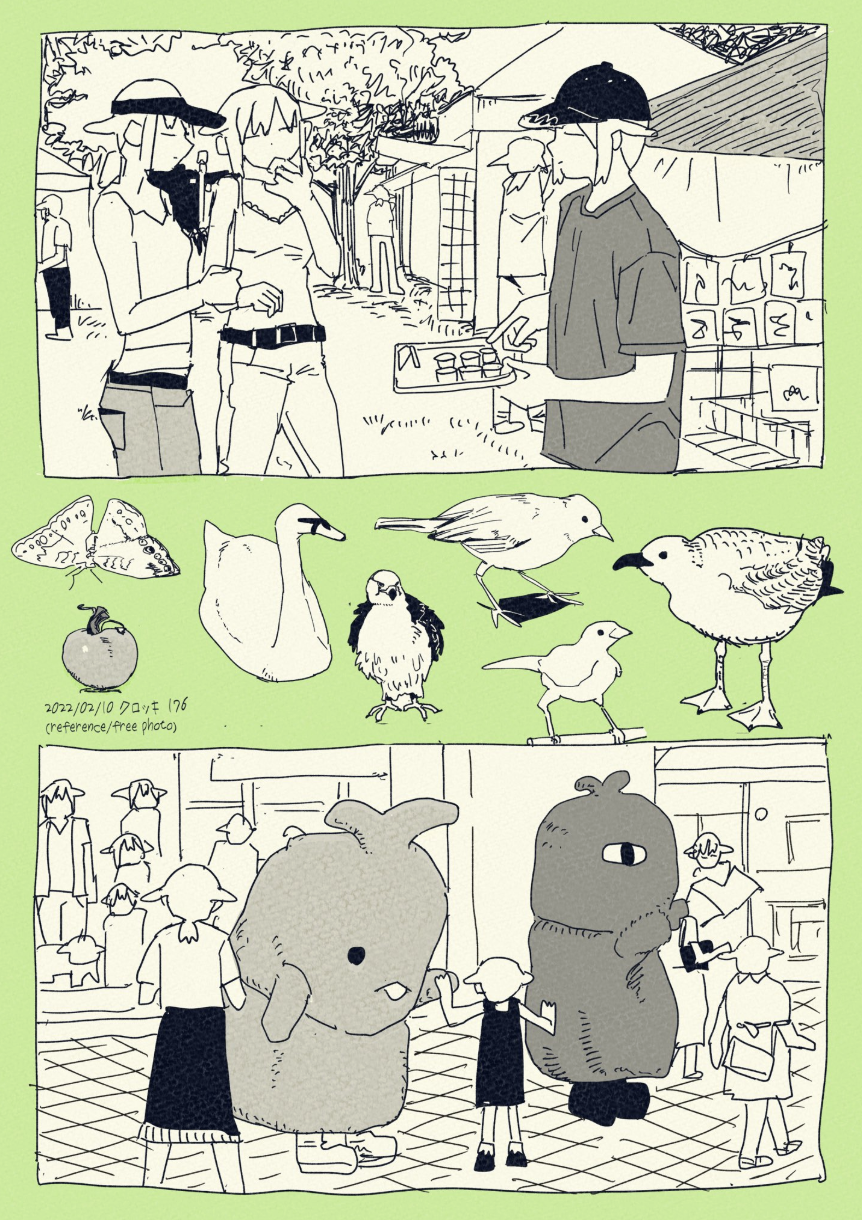
Mint Sketchbook Panels With Mascots
A loose, observational illustration page arranged like a sketchbook spread: thin black contour lines sit on a pale mint-green ground, with selective gray fills and cream panel interiors. The layout alternates between rectangular comic-like scenes and isolated study drawings, creating a quiet field-note rhythm. The mood is gentle, casual, and slightly deadpan; simplified human figures, birds, and rounded mascot forms are treated with the same economical line. Texture comes from hand-drawn wobble, sparse hatching, and uneven ink density rather than painterly surface.
Visual index
Form simplified human silhouettesrounded mascot bodiesbird-study profileseconomical facial featuresflattened comic-space perspective
Mood quietly playfulobservationalgentlecasualslightly surreal
Color pale mint-green backgroundblack ink lineworksoft gray spot fillswarm off-white panel fieldsrestrained monochrome palette
Texture thin pen contour lineslight hatchinguneven hand-drawn edgesflat gray wash-like fillsnotebook doodle quality
Composition stacked sketchbook-page layouttwo wide rectangular narrative panelsfloating specimen-like studies in the centergenerous negative spacecomic-panel framing mixed with observational notes
Related images
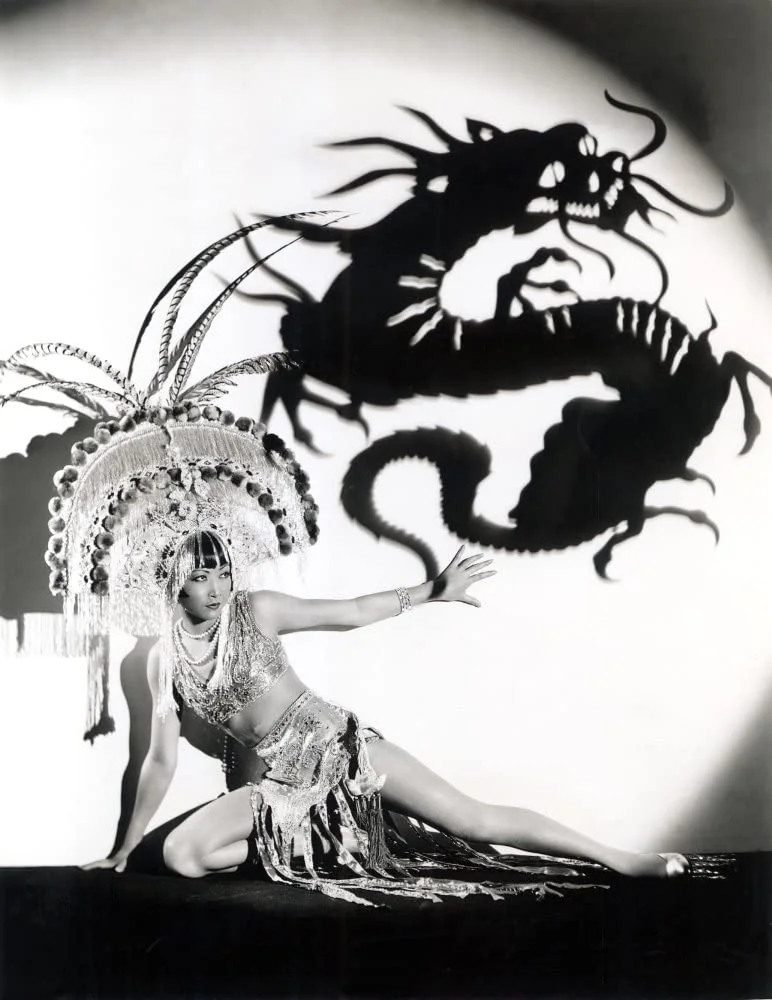
fr.wikipedia.orgformal echo
Ligne claire comic drawing
Hergé’s Tintin albums, especially street and market scenes in The Blue Lotus or The Crab with the Golden Claws
Look at how objects are separated by continuous contour lines, how shadows are minimized, and how background architecture remains legible without heavy tonal modeling.
Shared clean black contours, flat enclosed forms, minimal shading, readable panel staging
Different more casual sketchbook looseness, less polished perspective, muted mint monochrome instead of bright album color
Image search
Hergé Tintin The Blue Lotus street scene ligne claire panel
cultural lineage
Japanese slice of life manga observation
Kiyohiko Azuma’s Yotsuba&! everyday street and public-space scenes
Attend to the balance between simplified character design and lightly described real-world settings: the scene feels observed, but not over-rendered.
Shared everyday public setting, economical character poses, light environmental detail, gentle comic pacing
Different more experimental page layout, less conventional speech-and-panel sequencing, more sketch-study elements
Image search
Yotsuba&! manga street scene Kiyohiko Azuma panel

condenaststore.comcompositional relationship
Sempé style observational line illustration
Jean-Jacques Sempé’s crowd and city drawings for The New Yorker and Parisian illustration books
Notice the smallness of people within the environment, the lightly suggested architecture, and the way humor emerges from spacing and posture.
Shared thin nervous line, small social figures, open negative space, soft observational humor
Different less architectural scale, more manga-inflected faces, stronger mascot and animal-study presence
Image search
Jean-Jacques Sempé New Yorker crowd street line drawing
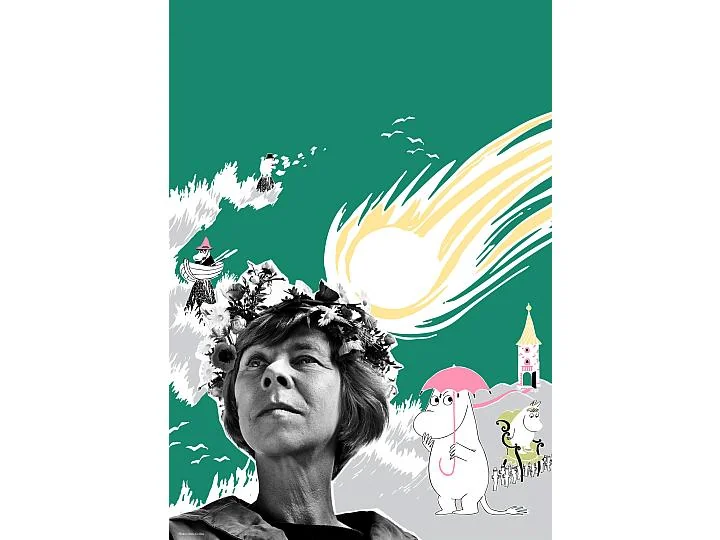
bklynlibrary.orgformal echo
Tove Jansson creature illustration
Tove Jansson’s Moomin book illustrations
Look for the combination of rounded silhouettes, small dot-like features, and selective texture marks that make imaginary bodies feel tactile but not heavily rendered.
Shared rounded creature silhouettes, small minimal faces, soft hatching, gentle surreal tone
Different more contemporary manga framing, less dense forest atmosphere, flatter graphic color field
Image search
Tove Jansson Moomin black white original illustration rounded creatures
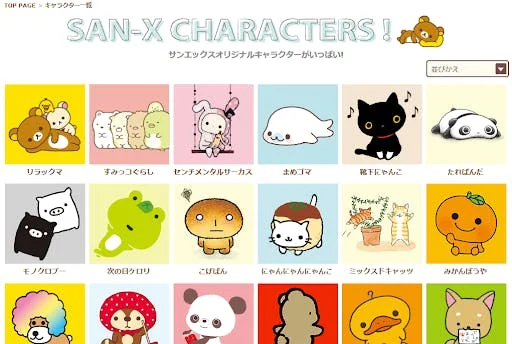
yumetwins.comcultural lineage
Japanese mascot character design
San-X character worlds such as Sumikko Gurashi and Rilakkuma
Focus on the low-detail faces, soft body geometry, and the way the characters function as graphic icons inside an otherwise observational scene.
Shared rounded bodies, tiny facial features, soft nonthreatening proportions, mascot-like presence
Different hand-sketch irregularity, monochrome restraint, more narrative urban context
Image search
Sumikko Gurashi San-X rounded character lineup simple faces
medium reference
Field guide sketchbook studies
Roger Tory Peterson’s bird field-guide plates and preparatory nature sketches
Notice the specimen-like spacing, the profile orientation, and the emphasis on identifying outline and posture rather than building a finished environment.
Shared isolated animal studies, profile silhouettes, observational contour drawing, annotated sketchbook feel
Different less scientific precision, more playful comic context, limited gray-green palette
Image search
Roger Tory Peterson bird field guide plate black and white sketches