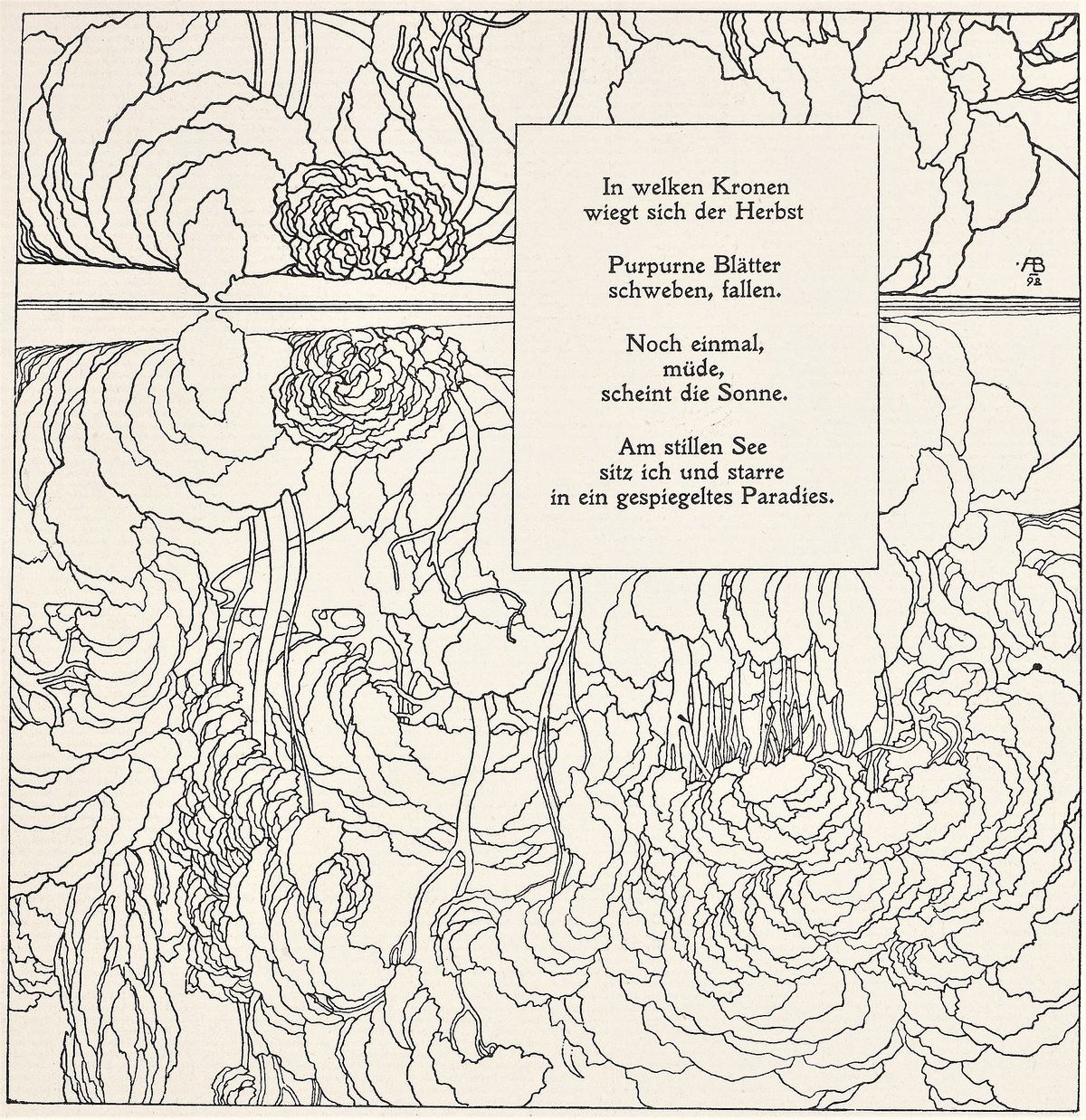
Mirrored Floral Poem Page
A monochrome Art Nouveau page built from dense, sinuous botanical linework surrounding a centered text panel. The composition feels like an ornamental pond seen through reflection: flowers, stems, and rippling contours repeat across a horizontal axis, while the poem sits in a calm rectangular reserve. The palette is restrained to black ink on warm paper, making rhythm, contour, and negative space carry the design. Its mood is quiet, autumnal, literary, and decorative, with a handmade fin-de-siècle print quality.
Visual index
Form sinuous plant stemslayered chrysanthemum-like blossomsflat outlined silhouettesorganic whiplash curvesbalanced text-and-image layout
Mood quietautumnalliterarycontemplativefin-de-siècle
Color black inkwarm ivory papermonochrome restraintsoft aged-paper tone
Texture fine pen-and-ink lineengraving-like contour workpaper grain warmthdense ornamental outlines
Composition square page formatcentral rectangular text blockhorizontal mirror/reflection axisall-over botanical surroundthin framing border
Related images
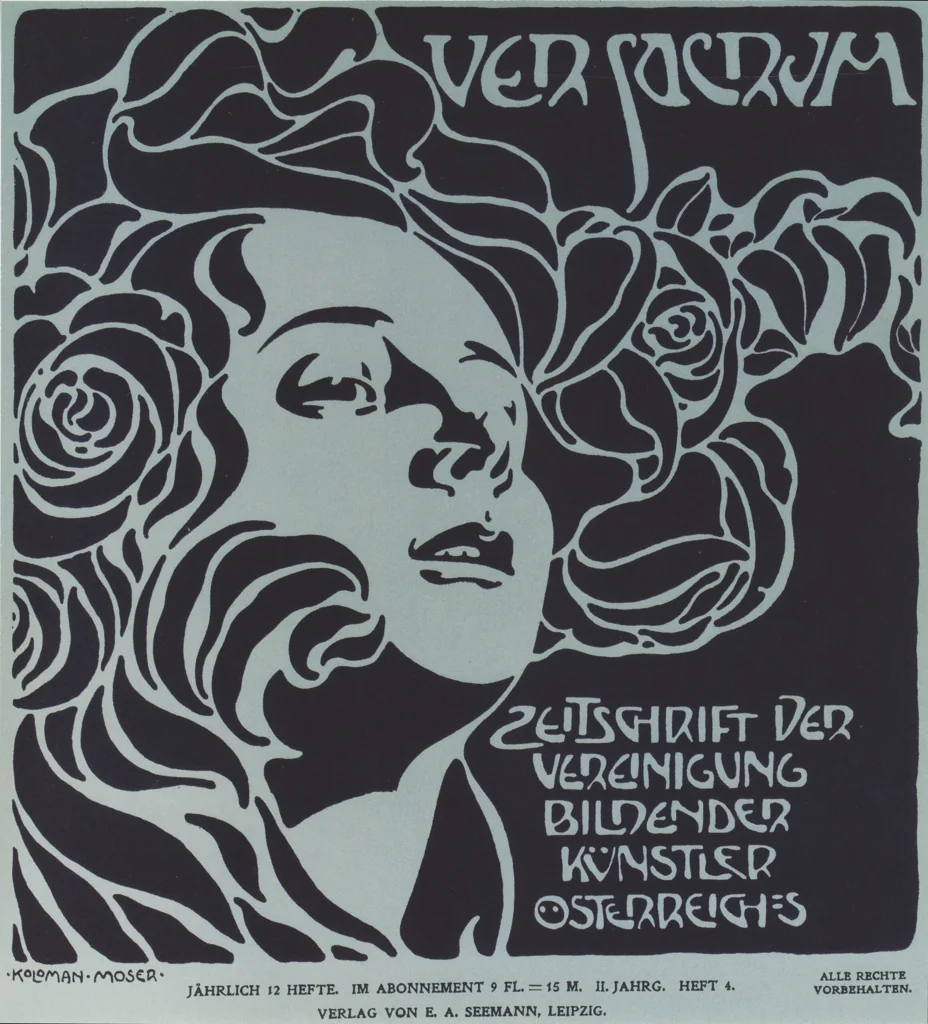
Artchiveperiod relationship
Vienna Secession graphic design
Koloman Moser, Ver Sacrum magazine covers and page ornaments, late 1890s
Look at how the image area is flattened into a decorative field, how plant forms become pattern, and how the border gives the page an architectural stillness.
Shared fin-de-siècle page design, flat ornamental field, botanical abstraction, careful text placement, thin linear border
Different more geometric Secession structure, often stronger color blocks, less naturalistic floral density
Image search
Koloman Moser Ver Sacrum floral cover
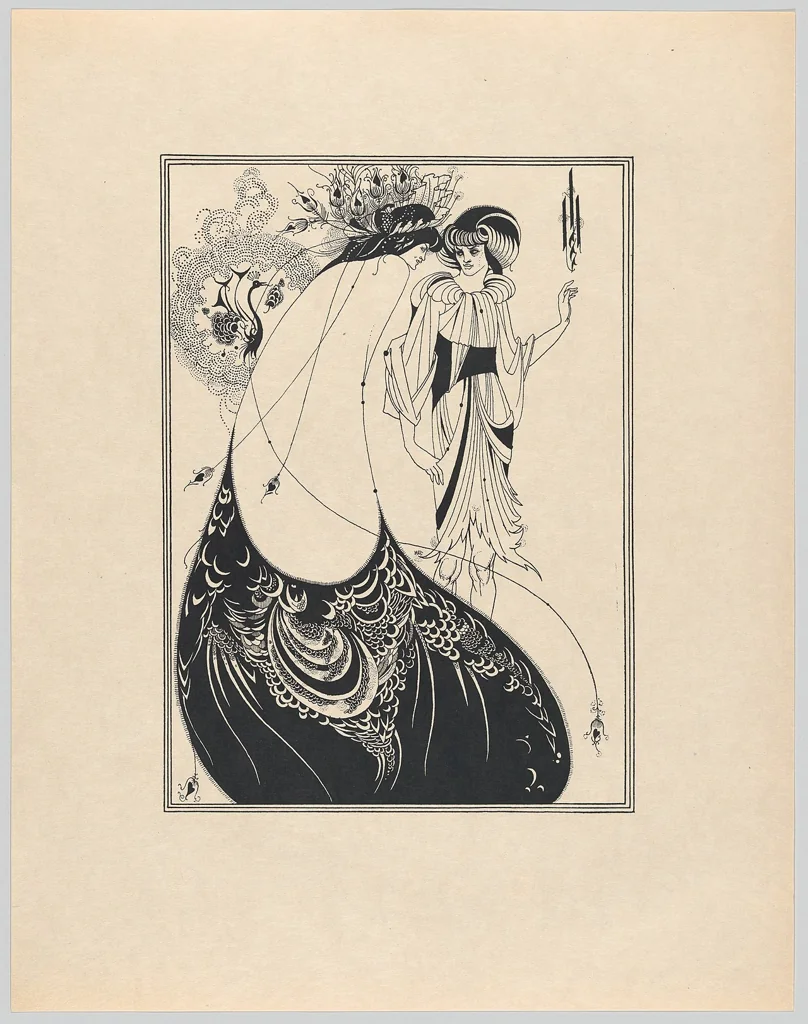
Wikimedia Commonsformal echo
Aubrey Beardsley linear Art Nouveau
Aubrey Beardsley, illustrations for Oscar Wilde's Salome, 1894
Attend to the fine contour lines, the disciplined use of empty white ground, and the way ornament becomes a self-sufficient graphic event.
Shared black-and-white ink drawing, decorative contour line, flat graphic space, literary page context
Different less erotic theatricality, softer botanical subject, lighter tonal contrast, more symmetrical reflection
Image search
Aubrey Beardsley Salome peacock skirt
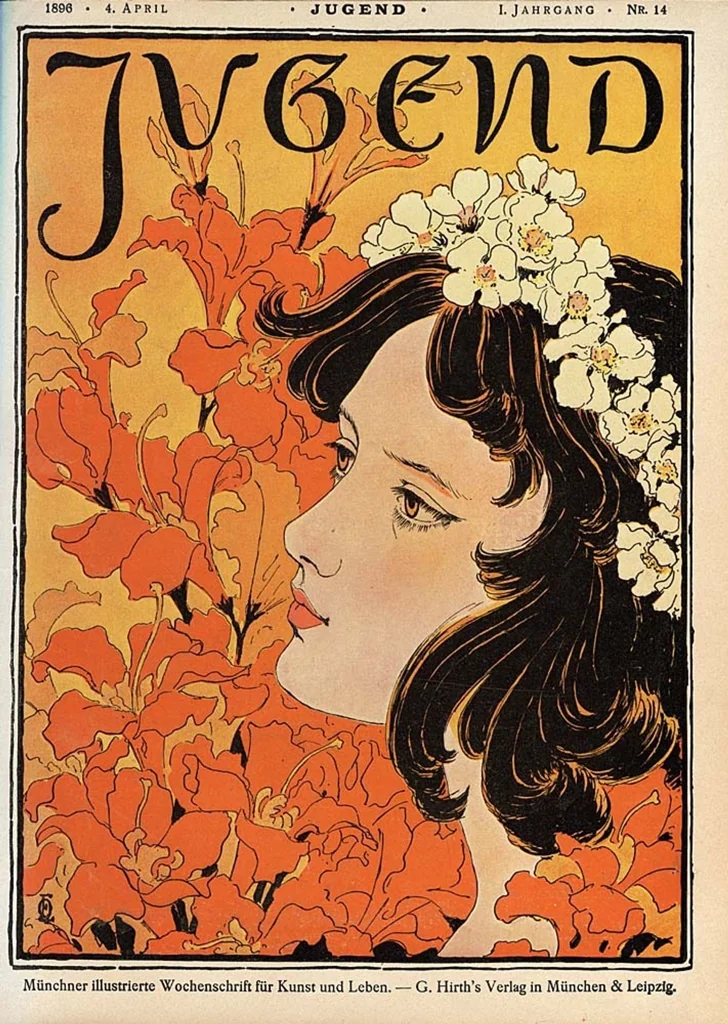
Arteracultural lineage
Jugendstil floral ornament
Otto Eckmann, Jugend magazine floral title designs, 1890s
Notice the flowing plant silhouettes, the tension between natural growth and designed pattern, and the preference for line over modeling.
Shared German Art Nouveau context, plant-derived ornament, flowing linear rhythm, decorative magazine-page sensibility
Different Eckmann often uses bolder silhouettes, more explicit lettering integration, less mirrored pond structure
Image search
Otto Eckmann Jugend floral ornament
Wikimedia Commonsmaterial kinship
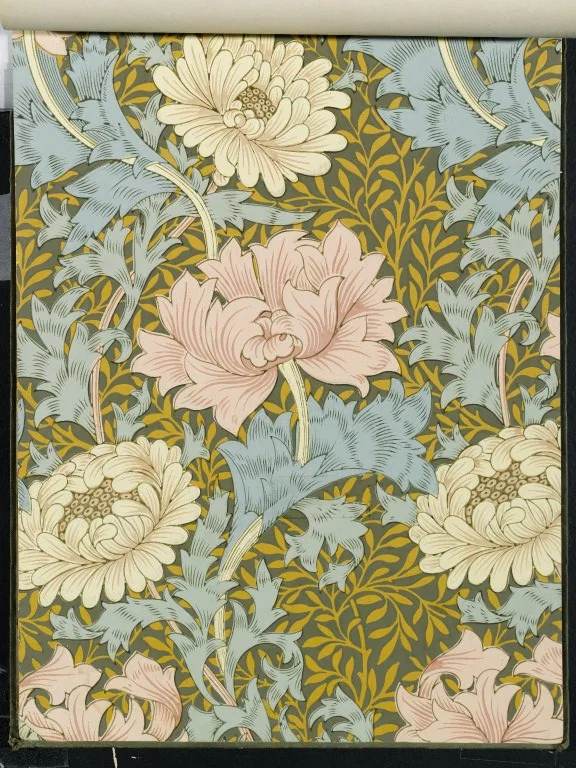
William Morris Arts and Crafts wallpaper
William Morris, Chrysanthemum wallpaper, 1877
Compare the repeated flower heads, the vine-like network, and the way the design fills the entire field without becoming a perspectival scene.
Shared all-over floral pattern, interlaced stems, layered blossoms, decorative surface logic
Different Morris is textile/wallpaper oriented, richer color palettes, more repeat-pattern regularity, less typographic integration
Image search
William Morris Chrysanthemum wallpaper
duille.comformal echo
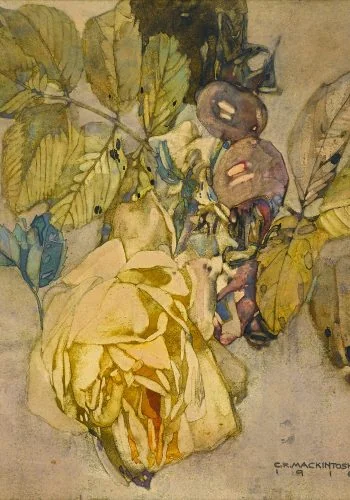
Charles Rennie Mackintosh botanical stylization
Charles Rennie Mackintosh, rose and plant studies, 1890s
Look for the elongated stems, simplified blossoms, and the balance between botanical observation and decorative abstraction.
Shared elongated stems, stylized floral forms, linear delicacy, quiet poetic mood
Different Mackintosh is more vertical and geometric, more spare negative space, less dense surface filling
Image search
Mackintosh rose plant study 1890s

Wikimedia Commonscultural lineage
Japanese ukiyo e influence on Art Nouveau
Ogata Kōrin, Irises screen, early 18th century
Focus on the shallow space, rhythmic plant clusters, and nature treated as pattern rather than illusionistic landscape.
Shared flattened natural forms, pond-like setting, rhythmic floral clusters, decorative asymmetry
Different painted color fields, screen format rather than printed page, broader brush forms, no integrated poem panel
Image search
Ogata Korin Irises screen